
You’ve decided to have plastic surgery. The surgeon has been chosen, the plans are coming together, but then one thought starts undoing all the certainty you had:
What if I don’t wake up from anesthesia?
So you research, double-check the surgical team, look up anesthesia deaths. Surely I couldn’t be the one person it happens to? Or maybe that’s just my luck. This is where knowing the statistics doesn’t always help.
Because knowing something is statistically unlikely doesn’t inherently make it emotionally insignificant, death is hardly a minor consequence.
The fear of not waking up is one of the most common preoperative worries. Up to 30% of patients experience anesthesia-related preoperative anxiety, with the fear of not waking up being the most commonly reported anesthesia-specific fear among surgical patients.
So what makes this such a common concern, and why does the thought persist even when you know how unlikely it is?
What the Statistics Can and Can’t Tell You
The point of this article is to put the risk back into perspective while looking at the different fears that can sit underneath it. Anesthesia-related mortality is estimated at roughly 0.0005%–0.001%, or around 1 in 100,000–200,000 cases.
But a population-level statistic isn’t the same as your individual risk. Your personal risk profile comes down to things like:
- Current health status
- Age
- Length and complexity of surgery
- Emergency vs. elective surgery
- Type of anesthesia
- Other relevant medical history, allergies and risk factors
Your anesthesiologist will discuss more of this with you. What I’m interested in is the psychological side of what the fear of going under entails.
Why the Statistics Don’t Settle the Fear
One of the thought patterns that can happen when you’re anxious about a catastrophic outcome looks something like this:
Possible → probable → about to happen to me.
An anxious mind can blur those categories, especially when the imagined consequence is irreversible.
So underneath the question, “What if I die?”, there is another question worth asking:
When you imagine not waking up from anesthesia, what part of that thought specifically scares you the most?
Once you know what you’re afraid of, you can determine what kind of problem you’re actually trying to solve.
What Sits Underneath “What If I Don’t Wake Up?”
“I’m scared of anesthesia” sounds specific, but psychologically it isn’t. Words mean different things to different people. Two people can say exactly the same sentence while being afraid of completely different things.
Here are five different fears that can sit underneath “What if I don’t wake up?”
1) Death itself scares me.
Sometimes the obvious answer is it. Death is frightening. There doesn’t always need to be a deeper psychological explanation.
2) I’m afraid of losing control.
Going under means temporarily losing your ability to monitor what is happening or intervene if something goes wrong.
3) I’m afraid of trusting someone else with my body.
This is slightly different from control. The fear is not only “I can’t intervene,” but “I have to trust somebody else to notice, respond and know what to do.”
4) I’m afraid of leaving people behind.
Sometimes the fear isn’t only death itself. It’s what death would separate you from: your partner, children, family, plans, and a life you’re not ready to leave.
5) I’m afraid because I chose this.
This is especially true for elective surgery. The fear can become: What if something happens because I voluntarily chose to do this? That can bring up guilt, imagined regret and the question of whether the change you want feels worth accepting even a small risk.
What Kind of Problem Is That Fear Creating?
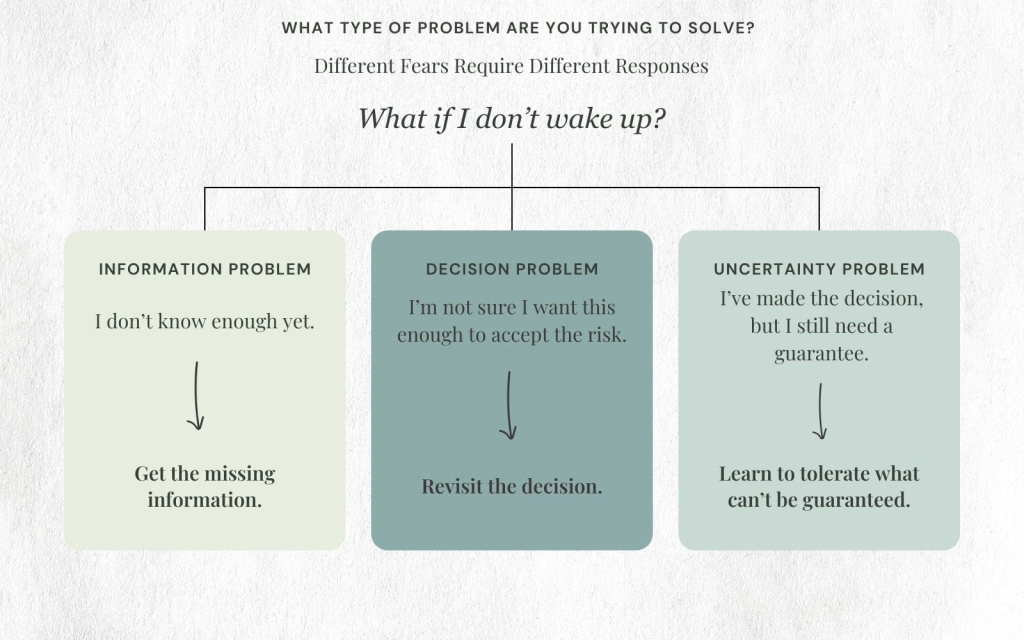
Fear of dying under anesthesia becomes easier to work with once you stop treating every fear as an information problem. Maybe you need information. Maybe you need to reconsider the decision. Or maybe you’ve reached the point where no additional information can give you what you’re actually asking for: certainty.
Sometimes the fear points to an information problem: there is something about your actual risk or medical plan you genuinely don’t understand.
Sometimes it points to a decision problem: you aren’t sure you want the surgery enough to accept that there is no zero-risk version of the choice.
And sometimes it becomes an uncertainty problem: you understand the risk, want the surgery and trust your team, but still find yourself searching for a guarantee nobody can give you.
Before Trying to Make the Fear Go Away, Ask These 4 Questions
- What exactly am I afraid of?
- Is there information I genuinely don’t have?
- Am I uncertain about the surgery itself?
- Or do I already have the information and the decision, but still want certainty?
Once you identify your answer, it will determine what deserves your attention next. If you’re missing information, get information from the appropriate medical professional. If you’re questioning the surgery itself, revisit the decision. And if you have the information and still need a guarantee, the problem may no longer be information. It may be uncertainty.
The Existential Question
Sometimes, once the medical questions have been answered, the fear opens up a question that medicine can’t answer:
What am I not ready to leave behind?
Imagining death can bring up the people you aren’t ready to leave, conversations you still want to have, or experiences you haven’t finished having.
Or it can reveal something simpler.
Maybe you’ve built a life you genuinely love, and you’re not ready to give it up.
That doesn’t mean fear of anesthesia is proof you have some deeply “unlived life.” Sometimes it’s the opposite.
It may be reminding you that you have a life you very much want to keep living.
The goal here isn’t necessarily to make the thought “What if I don’t wake up?” disappear. The goal is to understand what the fear is actually asking of you.
Do you need more information?
Are you still unsure about the decision itself?
Or have you reached the point where what you really want is certainty that nobody can give you?
Those are three different problems that require different responses.
Once you know which one you’re dealing with, the fear becomes easier to respond to without automatically trying to make it go away.